
Prince George's County Active Warrants Explained
An active or outstanding warrant is simply one the issuing court has not marked as served, recalled, quashed, or closed. The Prince George's County Sheriff's Office handles service of criminal and civil warrants countywide and publishes a public slice of that workload on its own pages. Treat the label as an agency status, though, not a full court history. A warrant can show as active in the Sheriff's system while the clerk is holding a recall order that has not yet reached the file you are reading. Only the court record settles that question.
What the Published Card Does Not Display
The public card layout in Prince George's County gives you a title, an image area, and a tip route. What is missing is everything you would need to tell one person from another.
- A warrant number, which the index does not expose
- A case or cause number to match against a court docket
- A date of birth to separate people who share a name
- The issuing court, so you know which clerk to call
- A bond amount, a release condition, or a status history
- An update timestamp or a statement of completeness
Note: Because those fields are absent, a card alone cannot tell you whether an order is current, recalled, or held by another court.
How Prince George's County Tracks Active Warrants
The Sheriff's Warrant/Fugitive Division receives warrants from the courts, enters them in its database, attempts service, and closes them out when service or a court order resolves the matter. The agency describes that entry and closure work in its own budget materials. No public page promises a refresh schedule. The Sheriff's Active Warrants page offers a single keyword field and the agency-published cards, and most readers in Prince George's County open that interface first.
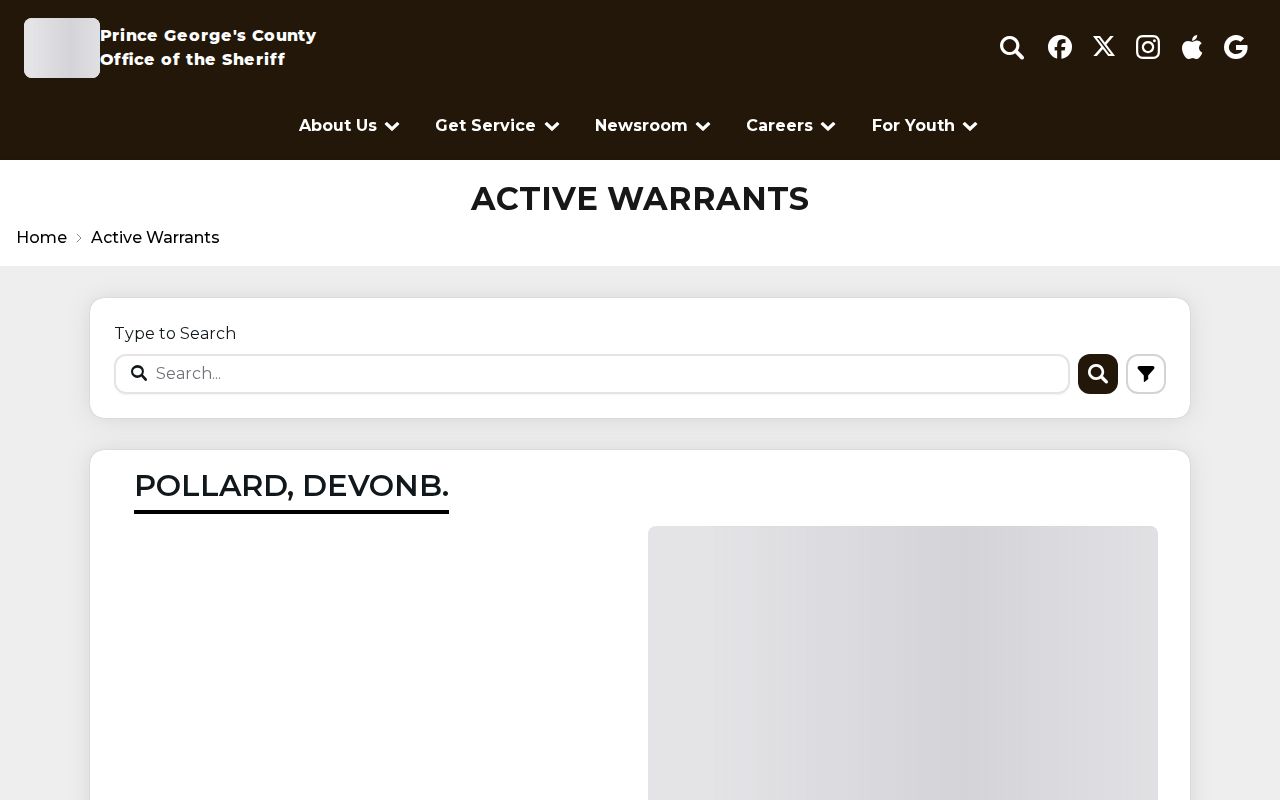
That heading, one search field, and the card layout make up the whole interface. Nowhere on it will you find a court dropdown, a warrant-type filter, or a bond field for Prince George's County cases.
Note: Absence from the page is not proof that no warrant exists. It may mean the order was never published, was recalled, or sits with a different court.
Felony Arrest and Wanted Wednesday Categories
The Active Warrant Database sorts its cards under program labels, and Felony Arrest and Wanted Wednesday are the two the agency shows on the index. Both reflect choices about what to publish, not a census of open warrants. A curated category works as a communication tool: it highlights cases the agency wants the public to see, and it says nothing about whether other warrants exist. Read the label as a signpost rather than a ranking. Each card also carries a tip link. That link exists for reporting information about a case, not for checking a status, so do not confuse the two when you look.
Inside an Active Warrant Record
A complete Prince George's County warrant record holds far more than the card does. Ask the clerk or the Sheriff to read these fields back to you.
| Warrant identifier | A court or agency number that ties the order to a case |
|---|---|
| Charge or offense | The offense listed on the charging document or docket |
| Issuing court | The District Court location or the Circuit Court that holds the case |
| Bond amount | Set by a commissioner or judge, and often unavailable online |
| Status | Active, served, returned, recalled, quashed, or closed |
| Holding agency | Whether the Sheriff has the order for service or the court still controls it |
A Recall Can Land Before the Card
Court and agency systems run on different clocks. A judge can recall a warrant mid-hearing while the Sheriff's card stays visible until the next refresh. The reverse happens too. A new warrant may sit in the system for days before anyone publishes it. That is why the confirmation habit matters more than the search habit. When a card and a clerk disagree, trust the court record and ask the Sheriff to update its file. Keep the order, the date, and the name of the person you spoke with in Prince George's County.
Warrant Roundups and Most-Wanted Lists
Prince George's County puts out most-wanted material through the Sheriff's Office and the Crime Solvers program. It does not run periodic warrant roundups. The county has no current warrant amnesty or safe-surrender event.
Key Point: The official Sheriff's most-wanted route and the Crime Solvers program are the authoritative sources, and their entries change as cases resolve.
The programs are described and linked, never reproduced. No names, photos, or roster entries appear, and none should appear in any summary you keep.
The full picture lives on the county's Most Wanted List page. That covers how tips are submitted in Prince George's County and what a tip can and cannot do.
Active Warrants and Court-Held Orders
Not every open order reaches a public card. A judge who issues a bench warrant for a missed appearance may leave enforcement to the court's own process. The Sheriff may never publish the item at all in Prince George's County.
| Order | Where it usually appears | How to confirm it |
|---|---|---|
| Felony arrest warrant | Sheriff cards and the Circuit Court docket | Sheriff warrant line and the Circuit Court clerk |
| District Court bench warrant | Case Search event history, sometimes a card | District Court clerk in Hyattsville or Upper Marlboro |
| Traffic failure to appear | The court docket and a Maryland MVA notice | District Court clerk, then MVA for the license flag |
| Body attachment | The civil or family docket | The clerk who holds the docket |
When Your Name Is on the Warrant List
Seeing your own name is the start of a process, not a verdict. Call the Sheriff first to ask whether the agency holds the order. Then call the issuing court and ask what the judge requires next. Three paths resolve an open order: a voluntary surrender when the court directs one, a bond posted under the court's instruction, and a motion to recall or quash that an attorney files. Maryland publishes no countywide bond schedule and no public recall form. Ask before you pay or travel, especially anywhere in Prince George's County.
Important: Speak with a lawyer before turning yourself in. An open warrant can be executed during any police contact, and clearing it takes a court order.
Confirming Status on the Sheriff's Warrant Line
The county routes outstanding-warrant questions about yourself or a family member to 301-780-8600. The Sheriff also publishes 301-780-8500 as its Teletype, Records, and After Hours number, and records requests go to the agency's custodian under the Maryland Public Information Act. On the call, ask five things: whether the agency holds the order, which court issued it, the case or warrant number, whether service has been attempted, and what the court's current instruction is. Write the answers down with the date.
Warrant Apprehension Funding and What It Means
Prince George's County budget papers show a Local Law Warrant Apprehension and Absconding Grant in the FY2025 approved budget. The FY2026 budget keeps that warrant apprehension and absconding grant funding going. Those dollars back the division's service work. Money alone is not a program, though. A grant line means the county invests in serving and closing warrants; it creates no amnesty, no roundup, and no new public portal. Read it as capacity context for why the Sheriff's published cards stay selective.