
Prince George's County Arrest Warrants Explained
An arrest warrant is a judge's signed command that a peace officer arrest the person named, and it must state the offense. Maryland law allows one only after a charging application clears a probable-cause review. Prince George's County sheriff's policy tracks those same two elements. Keep the signature and the charge in mind. Officers can also arrest on probable cause alone, with no warrant at all. So a clean warrant record does not rule out a charge; it only rules out that particular order.
How a Commissioner Reviews an Application
Most Maryland criminal cases start with an application for a statement of charges. A District Court commissioner reads it and can issue a summons instead of a warrant, or a warrant instead of a summons. The statute demands a probable-cause finding plus at least one listed circumstance. Examples include a served summons the person ignored, whereabouts nobody knows, custody already held on another offense, or a danger to a person or the community. That gate explains the paperwork you will see in Prince George's County. It names a specific offense and a specific court. It also explains why a warrant number and a case number sit side by side as two identifiers for one event. The full text is public, and the Maryland Criminal Procedure §2-607 page carries the probable-cause gate word for word.
Read that statute next to a real docket entry, and the commissioner's role clicks into place. A Prince George's County clerk can walk you through both for your own case.
Inside a Prince George's County Arrest Warrant
The full order holds more than any public interface shows. Use this checklist when you ask a Prince George's County clerk or the Sheriff what the file contains.
| Warrant or document identifier | The number the court or agency assigns to the order itself |
|---|---|
| Case number | The docket number used in Maryland Judiciary Case Search |
| Issue date | The date the commissioner or judge signed the order |
| Issuing authority | The commissioner or judge, and the court that holds the case |
| Charge and classification | The offense and its statutory class |
| Probable-cause reference | The statement of charges or affidavit behind the finding |
| Bond or release status | Cash, surety, personal recognizance, or no bond |
| Service and closure fields | The serving agency, the return, and any recall or closure date |
Note: A public card may show none of these fields, so treat the list as questions for the clerk and the Sheriff.
Serving Arrest Warrants in Prince George's County
The Prince George's County Sheriff's Office carries primary duty for serving criminal legal process, and its Warrant/Fugitive Division enters warrants, tries service, and closes them out. Deputy sheriffs also pick up people with outstanding warrants while they secure the courthouses. County police, city police, and other sworn officers can execute a warrant they run across on duty. A city department may make the arrest. Only the issuing court controls the recall, though, no matter who serves the order.
Who May Serve an Order Here
Service spreads across several agencies in Prince George's County, each with a defined role. Every row still points back to the issuing court, which owns the case.
| Agency | Role in service |
|---|---|
| Prince George's County Sheriff's Office | Primary legal-process agency; serves criminal and civil warrants, enters and closes them, and handles out-of-state fugitive returns |
| Prince George's County Police Department | Sworn officers may serve criminal process and run wanted checks during their work |
| Municipal police in Bowie, Greenbelt, Laurel, and Hyattsville | Local agencies may execute a warrant inside their jurisdiction and route city citations to the right court |
| Department of Corrections regional processing | Fingerprinting, criminal-history checks, commissioner presentation, and on-location warrant service |
| U.S. Marshals Service | Federal warrants and fugitives, plus federal and local task-force work |
Comparing Arrest, Summons, and Bench Warrants
Three documents can pull a person before a Maryland court, and the differences matter in Prince George's County. A summons asks you to come. An arrest warrant commands an officer to bring you. A bench warrant follows a missed obligation.
| Point | Arrest warrant | Summons | Bench warrant |
|---|---|---|---|
| How it starts | A charging application and probable-cause review | The same charging review, with a court date instead of custody | A missed appearance or another docket obligation |
| What it authorizes | Arrest | Notice to appear | Arrest |
| Who issues it | A commissioner or judge | A commissioner or judge | The judge holding the case |
| How it clears | Surrender, bond, or a recall order | Appearing as directed | A recall, reset, or new date |
What Happens After an Arrest
An arrest in Prince George's County is a step, not a finish line. County Corrections runs regional processing at the Correctional Center in Upper Marlboro and at Police District I Headquarters in Hyattsville. Published duties there include fingerprinting, criminal-history checks, presentation to a District Court commissioner, and warrant service on the spot. The Corrections division operations page lays out that sequence. The commissioner appearance is where a bond or release decision usually lands. Maryland Courts describes bail as a guarantee of appearance and warns that skipping court can forfeit it and trigger another warrant.
Note: Release timing, bond amounts, and no-bond conditions are case-specific and are not published as a county schedule.
The Search Warrant Is a Different Order
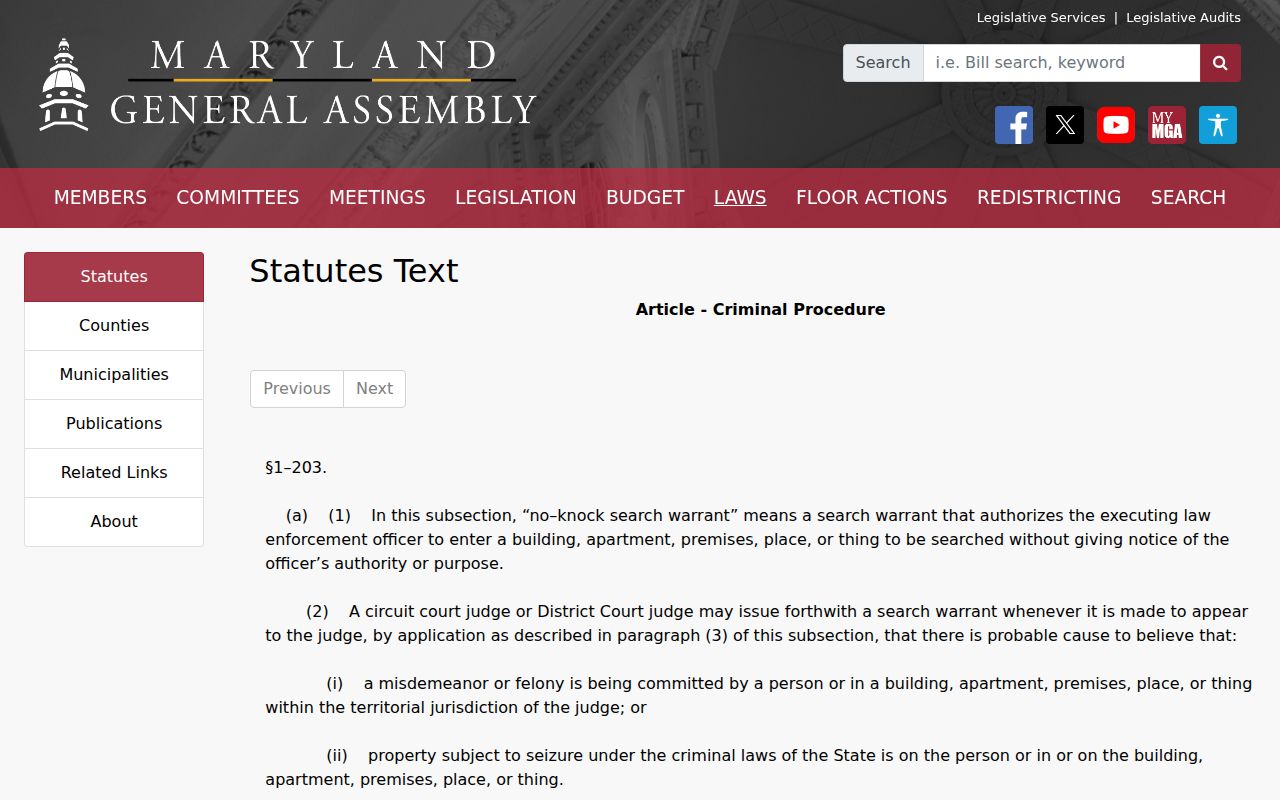
A search warrant does a different job in Prince George's County: it lets officers search a described place, person, or thing and seize described evidence. It names no one for arrest. It is no self-check tool either. Under Maryland Criminal Procedure §1-203, it takes a sworn written application and a probable-cause affidavit. Execution must happen within 10 calendar days. The return must be detailed, and a supporting affidavit can stay sealed while an investigation runs.
A Sealed Matter May Not Appear
Maryland access rules let courts withhold records that are sealed, shielded, expunged, juvenile, or otherwise restricted. So a sealed charging instrument or a confidential affidavit never shows in a public summary, and a blank search result is not a clearance. Case Search says the same thing in its own words. It is a summary, not the official record, and confidential matters do not come back. Prince George's County searchers should read the court records access rules and confirm their own case with the clerk who holds the file.
If There's an Arrest Warrant for You
Do not wait for a traffic stop. In Prince George's County, call the Sheriff and the issuing court, ask whether either holds the order, learn what the judge requires, and get the court's direction in writing if you can. Three paths close an open arrest warrant. A voluntary surrender can be arranged with counsel. A bond can be posted under the court's instruction. A motion to recall or quash can go before the judge.
Important: Consult an attorney first. A voluntary appearance is safer than an unexpected arrest, but only the court can set the terms.
Maryland publishes no countywide surrender window and no warrant bond schedule, so call before you travel. The countywide steps to clear a warrant keep the same order for Prince George's County readers: confirm, ask the court, then act.
Fugitive Matters and Out-of-State Warrants
The Sheriff's Warrant/Fugitive Division brings out-of-state fugitives back to face prosecution. That is why a warrant from another state can surface during a local traffic stop in Prince George's County. Treat each order as its own case. A Maryland warrant and an out-of-state warrant come from separate courts, and each issuing court controls its own paperwork. Federal matters sit outside this system altogether. A case filed in the U.S. District Court for the District of Maryland belongs to federal authorities, so it never shows up on a county active-warrant card. Confirm any federal charge through the federal clerk, not a county warrant lookup.